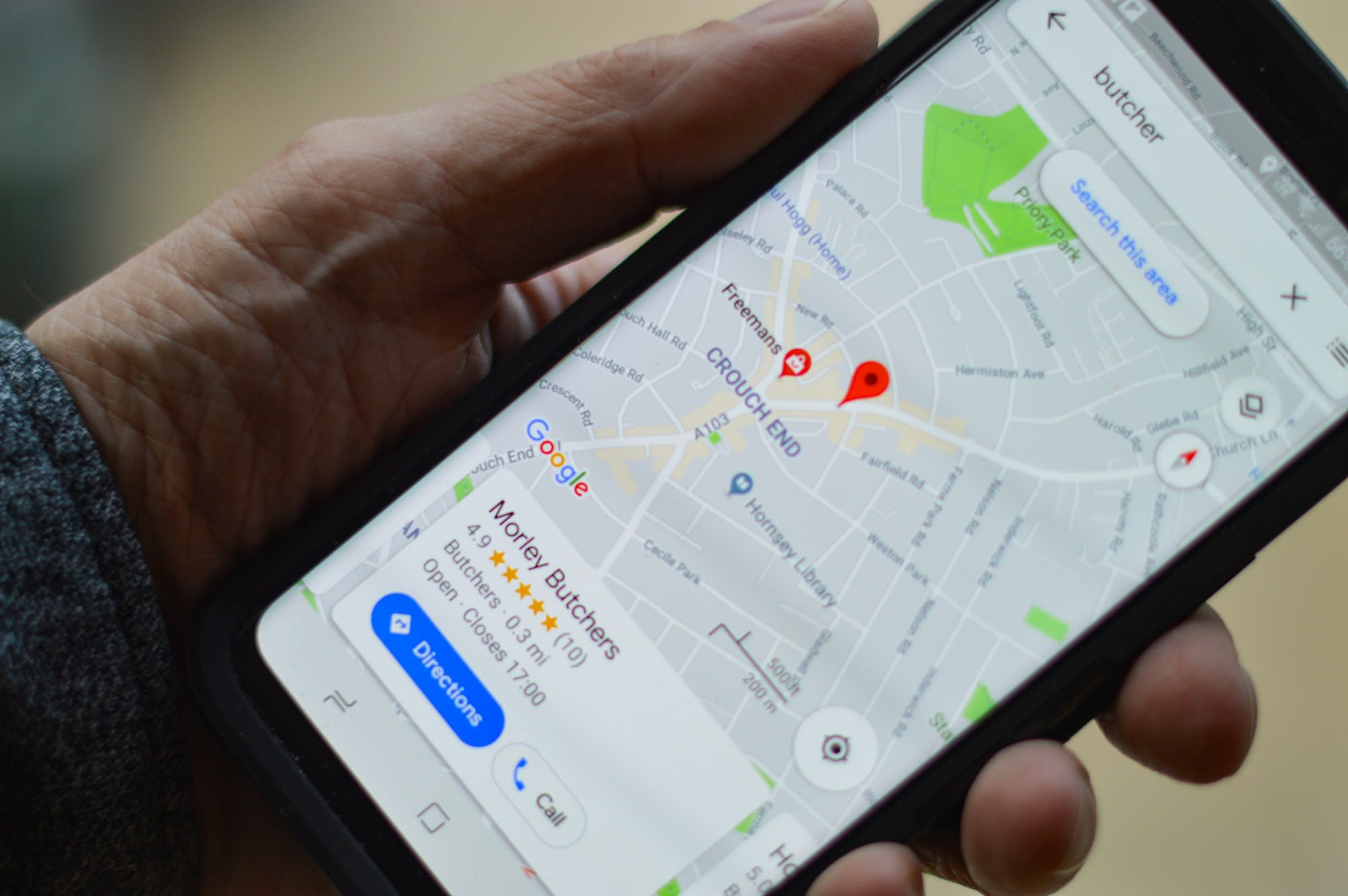
A box near the top of the results holds three businesses and a map. That box is the local pack, and for a service business it is the most valuable real estate on the page. Behind a link most people never click sits a much longer list called the Local Finder. One set of rules governs both, and those rules are not the ones that decide ordinary search results.
This page covers what the pack is, what sits behind it, how Google picks the three, and which parts of that you can actually influence. If you want the wider picture first, there is a separate guide to what local SEO is and how it works.
What the local pack is
The local pack — also called the map pack or the 3-pack — is the block of three business listings Google shows for a search with local intent. Each listing carries the business name, the star rating and review count, the category, and usually a phone or directions button. A map sits alongside it.
Two things make it matter more than its size suggests. It sits above the organic links, so it is the first result a reader sees. And it answers the question without requiring a click: a phone number and a rating are enough for somebody to decide. A person standing in a flooded kitchen is not opening three websites to compare.
It is also a different competition from the blue links underneath it.
| Local pack | Organic results | |
|---|---|---|
| What appears | Three businesses and a map | Ten page links |
| What is ranked | Your Google Business Profile | A page on your website |
| What decides it | Relevance, distance, prominence | Content, links, site authority |
| Who you compete with | Businesses near the searcher | Anyone who has written about it |
| Position on the page | Above the organic links | Below the pack |
The row that matters most is the second one. In organic search the thing being ranked is a page you own and control. In the pack it is a profile Google owns and you fill in. That single difference explains most of why local SEO work looks so unlike ordinary SEO work.
The Local Finder: the list behind the three
Under the pack there is a "More businesses" or "View all" link. Clicking it opens the Local Finder — the same results, unclipped. It is also what you get searching inside Google Maps directly.
The Finder shows a long ranked list rather than three, on a larger map you can pan and zoom, with filters for rating, hours and services. Each listing opens into the full profile: photos, description, services, Q&A and the complete review history.
It is ranked by the same three factors as the pack. There is no separate Local Finder optimisation, and anyone selling you one is selling you local SEO under a second name. What changes is not how you rank but who is reading:
- Position four still gets seen. Missing the pack is not missing the search. The Finder is where a business ranked fifth locally still has a chance of the job.
- The reader is further along. Somebody who clicked through to a longer list is comparing, not glancing. They will open profiles and read reviews.
- More of your profile is on show. The pack shows a name, a rating and a category. The Finder shows the photographs, the services list and the review history — which is why a thin profile costs you more here than in the pack.
The practical version: the pack rewards ranking, the Finder rewards a profile that survives being read closely. Both come from the same work.
How Google picks the three
Google states three factors: relevance, distance and prominence. They are worth taking literally, because each one is acted on differently and only two of them are yours to move.
Relevance
Whether your business matches what was searched. This is decided far more by your Google Business Profile categories than by anything on your website. Someone searching "emergency plumber" is matched against businesses whose profile says they are plumbers and that they do emergency work — the category first, the services list second, the description a distant third.
A business filed under the wrong primary category can do everything else right and never appear, because it is not in the set being ranked in the first place. Choose the most specific category that fits, not the broadest: "Plumber", not "Contractor". Then add secondary categories for the rest of what you do.
This is the cheapest thing on the list to fix and the most commonly wrong. It is a settings problem, not a marketing problem.
Distance
How far you are from the person searching, or from the place they named. You cannot change this, and a good deal of local SEO money is spent pretending otherwise.
What you can do is make sure Google knows where you are and where you work. For a storefront that means a verified, exact address. For a service-area business — a plumber, an electrician, a landscaper working out of a home office — it means hiding the street address and defining service areas instead, which keeps your home address off the internet and puts you in the running for searches across the areas you actually cover.
Be honest about the radius that buys you. One location does not rank across a metro area. Service-area businesses get some latitude, but far less than they are usually sold, and a strategy built on the assumption of more is a strategy built on a wish.
Prominence
How well known the business appears to be. Google reads this from reviews, from mentions and listings across the web, from links to your site, and from how established the profile looks overall.
This is the slow one. It takes months rather than minutes, it cannot be bought in a week, and it is the only one of the three that compounds. It is also the factor that lets a business slightly further away beat a closer competitor: strong prominence plus strong relevance will out-rank proximity alone more often than people expect.
So the order of work follows from the three. Fix relevance first, because it is a settings problem and it gates everything else. Accept distance and be realistic about it. Then spend the remaining effort, indefinitely, on prominence.
What to actually do, in order of payback
1. Get the profile right. Correct primary and secondary categories. Every service listed, with real descriptions. Accurate hours and service area. Real photographs of your own work, your own vehicles, your own crew — a profile with ten of those beats one with two stock images. Answer the questions in the Q&A rather than leaving them to whoever shows up. Our full guide to optimising a Google Business Profile goes field by field.
2. Keep reviews arriving. Not thirty in one month and nothing for a year. Pace and recency carry weight that a raw total does not, and a steady trickle reads as a working business where a burst reads as a campaign. Reply to them — all of them, briefly. Asking properly is most of it.
3. Make your listings agree. One name, one address, one phone number, identical everywhere it appears. Directories copy from each other, so one stale address propagates on its own, and Google notices when your listings disagree about who you are. It is the least interesting task on this page and usually the one with the most left to win. See NAP consistency for what counts as a mismatch.
4. Support it from the website. Pages that say what you do and where you do it, loading quickly on a phone, with your business details matching the profile exactly. Add LocalBusiness schema so the address, hours and phone number are machine-readable rather than inferred. If you genuinely work several distinct areas, a real page per area helps; five thin pages with the city name swapped out do not, and Google has been unimpressed by that pattern for years.
5. Earn local links and mentions. A sponsorship, a supplier's site, a local news piece, a trade association. These move prominence, and they are slow. They are also the part of the list a competitor cannot copy in an afternoon.
What usually goes wrong
- The wrong primary category, which quietly removes you from the set being ranked before anything else is considered.
- A street address on a service-area business, which both publishes your home address and narrows where you can appear.
- Listings that disagree because of an old suite number or a tracking phone number used on one directory years ago.
- Reviews in bursts, which looks exactly like what it usually is.
- Expecting a radius the business cannot hold, then concluding local SEO does not work when the metro-wide rankings never arrive.
- Treating it as a website problem. The site supports the profile. It is not the thing being ranked.
The short version
- The local pack is three business listings above the organic results, ranked from your Google Business Profile rather than your website.
- The Local Finder is the same results unclipped, behind "More businesses" — same ranking factors, but a reader who is comparing rather than glancing.
- Relevance, distance and prominence decide both. Relevance is mostly categories, distance you cannot change, prominence is the part that compounds.
- Fix categories first, define your service area honestly, then work on reviews and listings indefinitely.
- Missing the top three is not missing the search — the Finder is where a thorough profile earns the job.
Part of our local seo fundamentals guide
Local SEO: What It Is, How It Works, and Why It Pays
Or skip the work — See our local SEO work.
Ready to Grow Your Local Business?
Let's talk about your website and marketing. We'll put together a plan tailored to your business.
Let's talk about your site